


What Do Oral and Maxillofacial Surgeons Do? Key Procedures
Key Takeaways
- Oral and maxillofacial surgeons treat injuries and conditions of the mouth, jaw, and face.
- Becoming a surgeon requires approximately 12 to 14 years of education and training, offering a strong job outlook and an annual salary of around $334,310.
- AUAMED offers a well-rounded MD program with global clinical experience and good residency placement.
When someone suffers from a serious facial injury, needs corrective jaw surgery, or is born with a cleft lip or palate, oftentimes the person who steps in is an oral and maxillofacial surgeon. These specialists perform surgeries that can change a person’s ability to eat, speak, or simply feel confident in their appearance.
But what do oral and maxillofacial surgeons do daily? Their work stands out for its combination of dental training and surgical expertise.
✅ Request information on AUA's MD program TODAY!
To enter the field, oral and maxillofacial surgeons complete dental school and then go through four to six years of hospital-based surgical training. In fact, they perform around ten million wisdom teeth extractions each year in the United States alone. Still, many people are unaware of how important their work is.
Whether you’re a student considering this career or just someone curious about what happens behind complex facial surgeries, this blog will help you understand the world of oral and maxillofacial surgery.
What Is an Oral and Maxillofacial Surgeon?
An oral and maxillofacial surgeon is a medical professional who specializes in diagnosing and performing surgical treatments for conditions that affect the mouth, jaw, face, and neck. These specialists are trained in both dentistry and surgery, which allows them to manage everything, including complex tooth extractions or reconstructive facial procedures.
This profession bridges two fields, dentistry and medicine. Oral and maxillofacial surgeons are experts in oral health, but they also perform surgical procedures associated with medical doctors. Their scope of work includes correcting jaw misalignments, treating facial trauma, removing tumors or cysts, and performing reconstructive surgery for patients with facial differences such as cleft lip and palate.
Becoming an oral and maxillofacial surgeon requires advanced education and years of specialized training, apart from dental school. This preparation helps prepare professionals for both routine and emergency cases.
What Procedures Do They Perform?
Oral and maxillofacial surgeons perform a wide variety of complex procedures, including those of the head, neck, jaw, and face. Their work can range from treating injuries and correcting structural issues to removing tumors and improving facial function and appearance.
Due to their advanced training, they are trusted with delicate and life-changing procedures in both the dental and medical fields.

Trauma and emergency care
Oral and maxillofacial surgeons are critical in treating facial injuries caused by accidents, falls, sports incidents, or violence. Broken jaws, cheekbones, eye sockets, and facial cuts are a few examples of these injuries.
In these situations, the surgeon frequently works in conjunction with other emergency medicine specialists with the aim of restoring both function and appearance.
Treatment may include setting fractured bones, stitching soft tissue injuries, or performing reconstructive surgery. In some cases, temporary stabilization is used before going in with more advanced surgical repair.
Corrective jaw surgery
Corrective jaw surgery, also known as orthognathic surgery, is used to treat jaw misalignment that cannot be corrected with orthodontics alone. Oral and maxillofacial surgeons realign the jaws to improve chewing, speaking, breathing, and facial balance.
This surgery may be recommended for patients with underbites, overbites, open bites, or facial asymmetry. The process includes careful planning with orthodontists and may involve imaging, surgical repositioning of the jaws, and post-surgical recovery.
On the other hand, non-surgical options may include braces for milder cases, but complex misalignments would most likely require surgical correction.
Dental implants and bone grafts
Oral and maxillofacial surgeons are the specialists who place dental implants, such as artificial tooth roots, to support crowns or dentures.
Before implant placement, some patients may need bone grafting to strengthen the jawbone, especially if there has been bone loss due to injury, infection, or long-term tooth loss. Bone grafting can include using natural bone from the patient or synthetic materials.
This process requires precise surgical placement, healing time, and follow-up care. In cases where implants aren’t suitable, surgeons may use alternatives like bridges or dentures.
TMJ disorders and facial pain
Temporomandibular joint (TMJ) disorders can cause chronic jaw pain, headaches, and difficulty with chewing or jaw movement. Oral and maxillofacial surgeons evaluate these disorders to choose the best treatment course.
Nonsurgical options often come first and include medication, bite splints, or physical therapy. If symptoms continue, surgical options such as arthroscopy, joint repair, or even joint replacement may be necessary.
In these situations, the objective is to reduce pain, enhance function, and stop additional joint damage.
Oral pathology and biopsies
When abnormal growths, sores, or lesions appear in the mouth or jaw, oral and maxillofacial surgeons can evaluate and treat them. They usually perform biopsies to determine if a lesion is benign, precancerous, or cancerous.
Depending on the diagnosis, they may surgically remove cysts, tumors, or other abnormalities. Early detection and intervention are especially important, particularly for oral cancer. Follow-up care may include coordination with oncologists or other specialists.
Cosmetic and reconstructive surgery
In addition to functional procedures, oral and maxillofacial surgeons also perform surgeries to improve appearance and restore facial harmony.
Reconstructive surgery may be needed after trauma, cancer treatment, or congenital conditions like cleft lip and palate. Cosmetic procedures can include chin or cheek augmentation, facial contouring, and scar revision.
These surgeries aim to improve both aesthetics and self-confidence, often combining medical necessity with patient preferences.
What to Expect After Oral and Maxillofacial Surgery
Recovery after oral and maxillofacial surgery depends on the type and complexity of the procedure. Minor treatments, such as simple tooth extractions, require a few days of healing. On the other hand, more involved surgeries, like jaw realignment or facial reconstruction, can take several weeks or even months for a full recovery.
Common side effects include swelling, bruising, stiffness, and mild or moderate discomfort, particularly during the first few days. Patients can manage this pain with prescribed or over-the-counter medication, while cold compresses can help them reduce swelling.
For a smooth recovery, it’s important to follow postoperative instructions. This may include dietary guidelines, oral hygiene routines, activity restrictions, and medication schedules. Ignoring these directions may lead to complications or even delay the healing process.
In some particular cases, it may be necessary for follow-up care to monitor progress or remove stitches. For surgeries that affect jaw movement or facial muscles, it may be recommended to continue physical therapy to regain strength and function over time.
How to Become an Oral and Maxillofacial Surgeon
To become an oral and maxillofacial surgeon, the first step is pursuing an undergraduate education, typically with a focus on biology, chemistry, or a related science field.
Next, you must complete a Doctor of Medicine degree, which takes around four years at AUAMED. Its MD program has a clear medical school structure that focuses on learning by organ systems, allowing students to integrate clinical knowledge with foundational medical sciences from the start.
With 96% first-time USMLE Step 1 and 93% Step 2 CK pass rates, AUA graduates demonstrate strong academic performance. In 2025, they matched into over 137 residency programs across 35 U.S. states and Canada. The MD program includes 84 weeks of clinical rotations in the United States, Canada, the U.K., or India, following a preclinical period structured around organ-system learning.
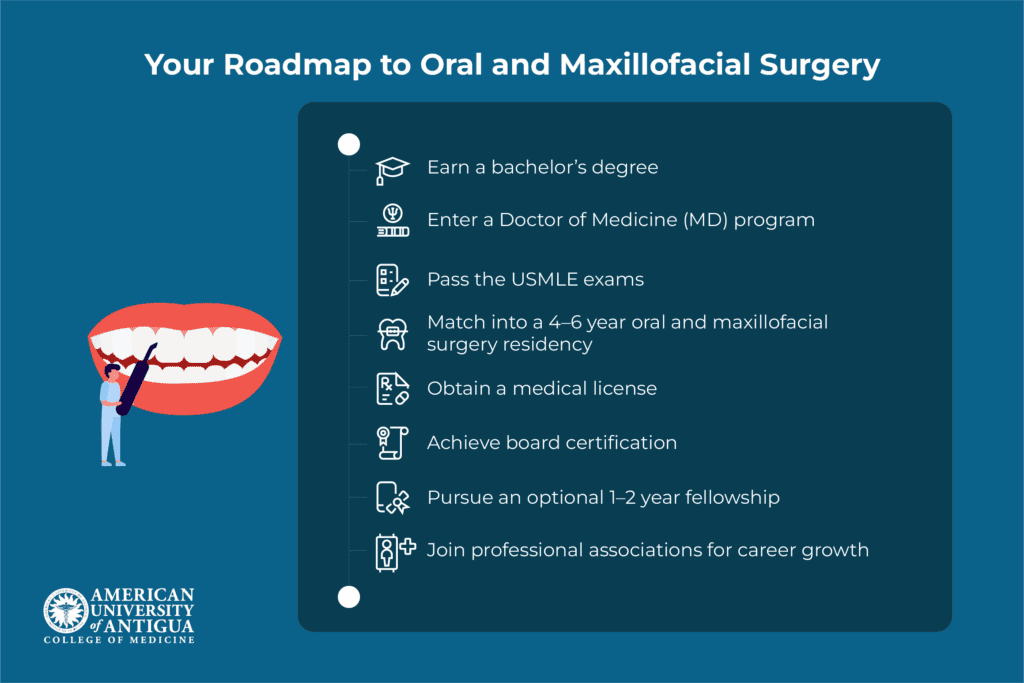
After earning an MD, you will need to complete a 4-6-year residency program in oral and maxillofacial surgery. These hospital-based residency programs offer intensive surgical training and experience in anesthesia, pathology, and trauma management.
Once your residency is complete, you must obtain licensure and pursue board certification through the American Board of Oral and Maxillofacial Surgery (ABOMS). This process includes passing written and oral exams. Many surgeons also become Fellows of the American College of Surgeons (FACS) to increase their professional credibility and expand opportunities.
For those who want to go further, optional fellowships that last around 1-2 years are available in cosmetic facial surgery, craniofacial reconstruction, head and neck cancer surgery, or pediatric maxillofacial care. These fellowships lead to highly specialized career paths within oral and maxillofacial surgery.
Skills and Qualities You Need to Succeed
Apart from medical knowledge, becoming an oral and maxillofacial surgeon requires a unique combination of physical skill, emotional intelligence, and mental resilience. Here are some of the key skills and qualities needed to succeed in this profession:
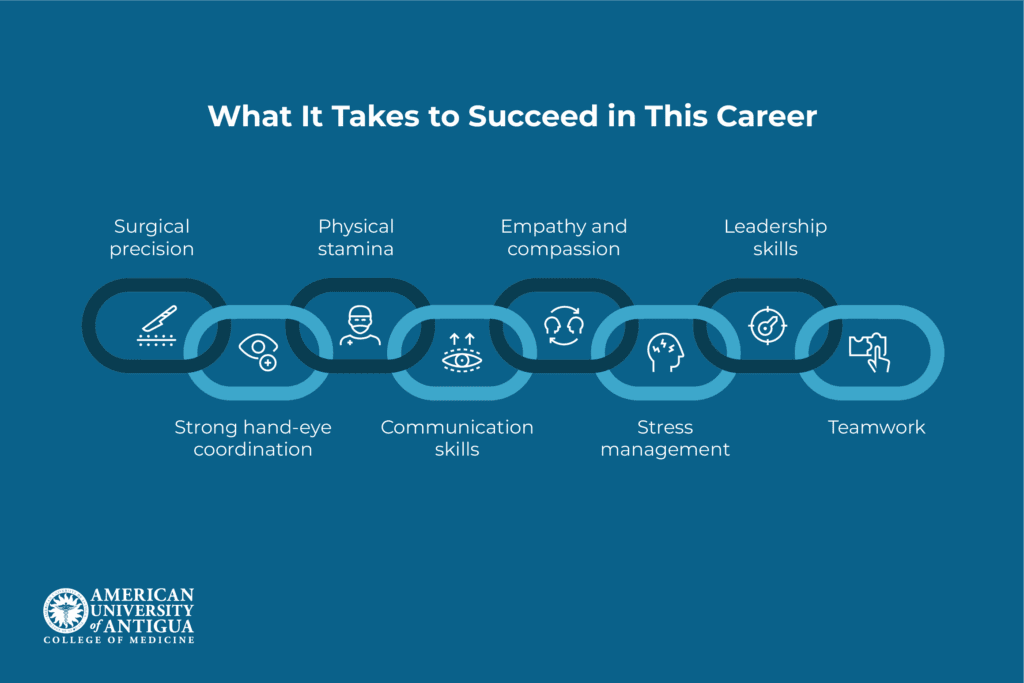
- Surgical precision: Delicate procedures on the face, mouth, and jaw require exceptional accuracy and attention to detail.
- Strong hand-eye coordination: Surgeons must take charge of instruments with extreme care, often in tight and sensitive areas.
- Physical stamina: They must stay focused and physically steady through long hours in the operating room.
- Communication skills: Clear communication with patients, families, and medical teams is essential before, during, and after procedures.
- Empathy and compassion: Many patients face fear, pain, or life-changing diagnoses, and surgeons must offer expert care and emotional support as they experience these changes.
- Stress management: High-pressure situations, especially emergencies, require calm focus and the ability to make quick decisions.
- Leadership skills: Surgeons often direct the course of complex procedures and delegate responsibilities during surgery.
- Teamwork: Collaborating with nurses, anesthesiologists, and surgical assistants is essential to ensure success in the operating rooms.
Why Choose This Career
Oral and maxillofacial surgery enables surgeons to improve patients’ quality of life. Whether by bringing back smiles after injury or correcting functional problems, the impact on patients’ health and self-esteem can be life-changing.
The career offers a strong job outlook, as employment for surgeons is expected to grow by 3% until 2033, including oral and maxillofacial surgeons. They earn a median annual salary of $334,310, reflecting the high level of skill and training required.
Apart from clinical work, oral and maxillofacial surgeons have opportunities to engage in research, teach future professionals, and pursue subspecialties such as facial reconstruction or oncology.
Additionally, these surgeons work at the intersection of medicine and dentistry and are recognized for their expertise in complex surgical care.
Conclusion
Becoming an oral and maxillofacial surgeon offers individuals a sense of professional fulfillment in making a meaningful difference in patients’ lives. They help people regain function, appearance, and confidence after an injury or illness.
The field also provides a strong job outlook, as demand for skilled surgeons is expected to grow steadily, and competitive salaries that mirror the extensive training and expertise required.
In addition to clinical practice, this career offers opportunities for research, teaching, and further specialization for surgeons to advance the field of medicine and mentor the next generation.
AUAMED offers a strong foundation through an integrated, systems-based curriculum that prepares students for clinical practice from the very beginning of their careers.
If changing people’s lives is your goal, AUAMED can help you take the first step.
Frequently Asked Questions
Which condition is most likely treated by an oral and maxillofacial surgeon?
An oral and maxillofacial surgeon most commonly treats impacted wisdom teeth, oral and facial trauma, and jaw disorders.
How much does an oral and maxillofacial surgeon earn on average?
On average, an oral and maxillofacial surgeon earns around $334,310.
How long does it take to become an oral and maxillofacial surgeon?
It usually takes 12 to 14 years, including 4 years of undergraduate studies, 4 years of dental school, and 4 to 6 years of hospital-based residency.
✅ Request information on AUA's MD program TODAY!
