


ECFMG Certification: Steps, Requirements & Process
Key Takeaways
- ECFMG certification is mandatory for IMGs to enter U.S. residency programs and obtain medical licensure.
- The process requires passing USMLE Step 1 and Step 2 CK, plus verification of medical school credentials.
- Certification typically takes 4-8 weeks after all requirements are met, though school verification can add months.
- Your medical school must be listed in the WDOMS to qualify.
For many aspiring doctors, practicing medicine in the United States represents a version of the American dream. Whether it’s international students hoping to build a life in the U.S. or American citizens who choose to pursue medical education abroad before returning home, the path to a U.S. medical license often begins outside the country.
Medical schools around the world offer high-quality training, but they aren’t all required to follow the same standards, guidelines, or clinical frameworks used in the U.S. healthcare system. That’s why ECFMG certification exists.
✅ Request information on AUA's MD program TODAY!
What Is ECFMG Certification?
ECFMG certification is a credential that confirms international medical graduates have met established standards for medical education and clinical knowledge. The ECFMG, founded in 1956, operates as a non-profit organization that evaluates the qualifications of physicians who received their medical training outside the U.S. and Canada.
This certification serves three primary purposes:
- Standardization: It ensures that International Medical Graduates (IMGs) possess medical knowledge and clinical skills comparable to U.S. medical graduates, protecting patient safety and healthcare quality.
- Gatekeeping: It acts as a prerequisite for entering medical residency programs in the United States, regardless of where you completed medical school.
- Licensing pathway: Most state medical boards require ECFMG certification before issuing medical licenses to IMGs, making it essential for long-term practice in the U.S.
ECFMG Eligibility Requirements
Before applying for ECFMG certification, you must meet specific eligibility criteria related to your medical education and institutional recognition.
Your medical school must be listed in the World Directory of Medical Schools (WDOMS), a database jointly maintained by the World Federation for Medical Education (WFME) and the Foundation for Advancement of International Medical Education and Research (FAIMER).
The WDOMS listing confirms that your institution offers a medical program leading to a degree that is:
- Recognized for medical practice in the country where the school is located
- Of sufficient duration and content to prepare students for medical practice
- Supervised by the appropriate medical faculty
The WDOMS listing must include a specific ECFMG note stating that students/graduates are ECFMG eligible. Simply being listed is not sufficient without the ECFMG eligibility annotation. Schools not listed in it do not qualify, regardless of the quality of education they provide.
You must have completed (or be in the final year of) a medical curriculum that meets these standards:
- At least four academic years of instruction
- A curriculum that includes both basic sciences and clinical training
- Verification that you’ve completed all required examinations at your medical school
ECFMG requires official documentation from your medical school, including:
- Final medical diploma: Proof of degree completion
- Medical school transcript: Complete academic record showing courses and grades
- Medical Student Performance Record (MSPR) or equivalent: A dean’s letter or similar document describing your medical education
Your medical school must submit these documents directly to ECFMG through secure channels. You cannot submit them yourself. AUA is fully accredited by the Caribbean Accreditation Authority for Education in Medicine and Other Health Professions (CAAM-HP), recognized by the U.S. Department of Education, and its students are ECFMG-eligible.
How to Apply for ECFMG Certification
The application process for ECFMG certification occurs entirely online through the ECFMG’s Interactive Web Applications (IWA) portal. Here’s what you need to know:
For the application process, make sure you:
- Create an IWA account: Visit ecfmg.org and navigate to the IWA login page. You’ll need a valid email address, personal identification information, and your USMLE identification number (if you already have one).
- Complete your application profile: Provide biographical information, medical school details, and upload a passport-style photograph that meets ECFMG specifications.
- Pay application fees: As of 2025, the ECFMG certification application fee is $560.
Before applying, gather:
- Form 183 (ECFMG Certification Application): Completed online through IWA
- Form 186 (Medical School Transcript Request): Your medical school must complete this to verify your credentials
- Passport or government-issued photo ID: For identity verification
- Medical diploma (if graduated): To be sent directly from your medical school
The application itself takes 30-60 minutes to complete, but document processing can take much longer. Medical school verification often requires 8-12 weeks, and some institutions take even longer. Apply early—ideally during your final year of medical school—to avoid delays in your residency application timeline.
Required Exams for ECFMG Certification
ECFMG certification requires passing scores on two USMLE examinations that assess your medical knowledge and clinical reasoning.
USMLE Step 1
USMLE Step 1 is a computer-based exam that tests your understanding of basic medical sciences, including anatomy, biochemistry, physiology, pharmacology, pathology, and microbiology. As of 2022, Step 1 uses pass/fail scoring rather than a numerical score.
USMLE Step 2 CK
USMLE Step 2 CK evaluates your ability to apply medical knowledge and clinical science principles to patient care. It focuses on diagnosis, disease management, and preventive medicine across various medical specialties.
USMLE Step 2 CS
USMLE Step 2 CS (Clinical Skills), which previously assessed clinical communication and examination skills through standardized patient encounters, was permanently discontinued in 2021. It is no longer required for ECFMG certification. However, many residency programs now use alternative clinical skills assessments during interviews or orientation.
Step-by-Step Process to Get Certified
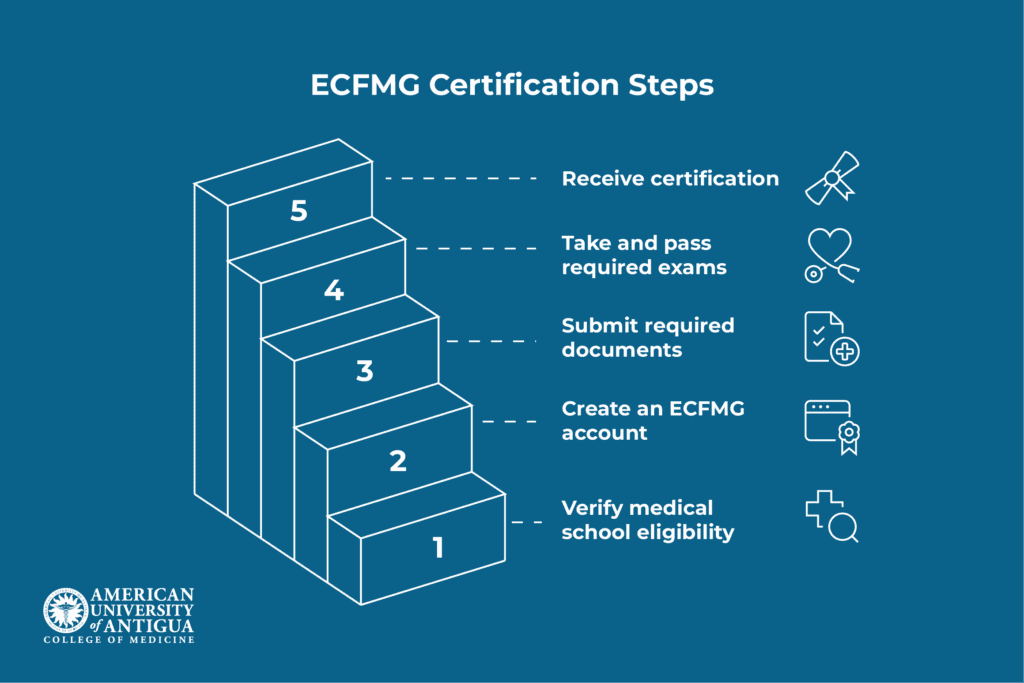
Obtaining ECFMG certification involves five distinct stages, each with specific requirements and timelines.
Step 1 – Verify medical school eligibility
Before investing time and money in USMLE exams, confirm that your medical school is listed in the WDOMS with a note indicating ECFMG eligibility.
Visit wfme.org or search directly on the ECFMG website. Look for your institution’s Sponsor Note, which specifies whether graduates are eligible for ECFMG certification. Schools without a Sponsor Note or with notes indicating ineligibility cannot certify their graduates through ECFMG.
AUA’s MD program comprises two years of Preclinical Sciences on its Antigua campus and 84 weeks of Clinical Sciences rotations in teaching hospitals across the US, Canada, India, and the UK. This structure aligns with ECFMG requirements and prepares students for successful certification.
Step 2 – Create an ECFMG account
Register through the IWA portal at ecfmg.org. You’ll receive a unique USMLE/ECFMG identification number that stays with you throughout your medical career. Keep this number secure—you’ll use it for all USMLE registrations, ECFMG communications, and residency applications.
During registration, you’ll provide:
- Personal identification information
- Medical school details
- Contact information
- A digital photograph meeting ECFMG specifications
Step 3 – Submit required documents
Through your IWA account, initiate the credential verification process by requesting that your medical school complete Form 186 (Medical School Transcript). Your school must:
- Verify your enrollment and graduation status
- Confirm your completion of all medical curriculum requirements
- Send official transcripts directly to ECFMG
- Provide a copy of your medical diploma (if graduated)
You cannot submit these documents yourself. ECFMG requires direct communication from your medical school’s registrar or official credentials office to prevent fraud. Allow 8-12 weeks for this process, though some schools take longer.
Step 4 – Take and pass required exams
Register for USMLE Step 1 and Step 2 CK through the ECFMG website. When scheduling, select ECFMG as a score recipient so your results are automatically forwarded.
Exam preparation timeline:
- Most students spend 4-6 months preparing for Step 1
- Step 2 CK preparation typically requires 3-4 months
- Many students take Step 2 CK within 6-12 months after Step 1
Small class sizes make it ideal to ask questions, connect with professors, and get personalized feedback. Rather than being lost in the crowd, you can find help and support easily. This personalized approach supports strong USMLE performance.
Step 5 – Receive certification
Once you’ve passed both required exams and ECFMG has received and verified your medical school credentials, certification is typically issued within 4-6 weeks. You’ll receive an official ECFMG certificate and a notation in the ECFMG database confirming your certified status.
This certification enables you to:
- Register for the Electronic Residency Application Service (ERAS)
- Apply for residency positions in ACGME-accredited programs
- Begin the pathway toward U.S. medical licensure
How Long Does ECFMG Certification Take?
From start to finish, most IMGs complete ECFMG certification in 12-18 months. This includes:
- Exam preparation and testing: 8-12 months
- Medical school document processing: 8-12 weeks
- Final certification processing after all requirements met: 4-6 weeks
However, many students begin the process during medical school and complete certification shortly after graduation, especially if they take Step 1 during their second year and Step 2 CK during their third or fourth year.
Several variables can accelerate or delay your certification:
- Exam scheduling and performance: Testing centers may have limited availability, especially in certain regions. First-attempt failures add 3-6 months for study and retesting.
- Medical school verification delays: Schools with large international student populations or bureaucratic processes may take 3-6 months to process credential requests. Some schools only submit documents at specific times of year.
- Document accuracy: Errors or inconsistencies between your application and school records trigger additional verification steps that can add weeks or months.
- Graduation timing: If you apply before graduating, you’ll receive only partial verification until your medical school confirms degree completion.
After ECFMG Certification: Next Steps
Earning your ECFMG certification is a defining step toward becoming a U.S. physician, but it also opens the door to several important next stages. Your first priority is registering with ERAS, which most programs use to review applicants.
ERAS opens for registration in June, applications begin in September, and Match Day arrives in March, marking the start of your residency journey. A strong application blends strong USMLE scores, persuasive personal statements, and credible U.S. clinical experience through observerships or externships.
AUA graduates benefit from the university’s clinical partnerships with teaching hospitals across the United States, opportunities that make it easier to gain the kind of hands-on experience residency directors look for. Once matched, your certification also fulfills one of the essential requirements for medical licensure in all 50 states, alongside completing Step 3 and an ACGME-accredited residency year.
While ECFMG certification does not expire, it must be valid at the time you begin residency, and if you postpone training, it’s important to verify with ECFMG and your intended state medical board that no new criteria have been introduced.
Conclusion
For international medical graduates, ECFMG certification is what makes it possible to practice medicine in the United States, but the process of getting there demands early planning, focused exam preparation, and careful attention to credential verification, all while balancing the demands of medical school. Staying organized, communicating clearly with your institution, and asking for guidance when needed can make the difference between delays and a smooth transition.
At the American University of Antigua, students receive support every step of the way when they join our MD program. If you’re looking for an internationally respected education that prepares you for a successful U.S. residency, AUA might just be the perfect match for you.
Frequently Asked Questions (FAQs)
How long is ECFMG certification valid?
ECFMG certification remains valid indefinitely once you’ve met all requirements and must be active when you begin residency training.
Can I apply without graduating from medical school?
You can begin the application process during your final year, but full certification isn’t granted until your medical school confirms graduation and degree conferral.
✅ Request information on AUA's MD program TODAY!
